


How Jennifer Hinds Took an ‘Aha’ Moment and Turned it Into Her Legacy
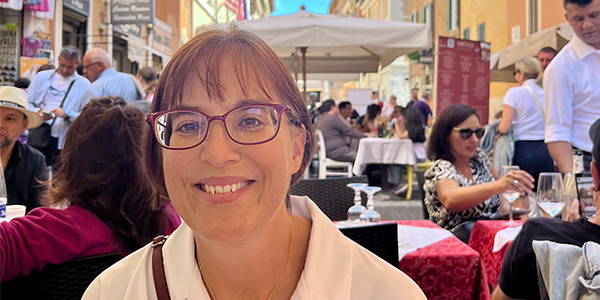
In 2018, Jennifer and Gary Hinds sold their business and overnight, their financial world changed. With a portion of the proceeds moved into a donor-advised fund, Jennifer found herself asking a question she had never had the luxury to ask before: What do we really want to pursue?
For Jennifer, the answer came from a place both professional and deeply personal. Her career had been in accounting and business software, steeped in data analysis and statistics. But when she looked at the full breadth of human need, one thing stood out above all others: health.
"When your health isn't good, everything else falls apart. There is so much we don't know - and
it affects people in such immense ways."
- Jennifer Hinds
A personal connection
The stakes of health have never been abstract for Jennifer, with her family carrying a history of autoimmune diseases. "We recognize that there are tons of people out there who have immune responses and we still can't put a name to it," she says. That recognition, that the edges of what science knows still leave so many people without answers, became the lens through which she began searching for an organization truly deserving of her support.
The moment science came alive
Jennifer will readily admit she is not a science-trained person. What drew her to LJI, she says, was that she didn't need to be. The Institute's researchers write about their work in a way that invites non-scientists in - accessible enough for a lay person to have, as she puts it, "an aha moment."
That aha moment became visceral the day she visited LJI's flow cytometry core. Flow Cytometry Senior Core Director Cheryl Kim was actively running samples while Jennifer watched - a machine feeding specimens through in real time, plotting each one as a point on a scatterplot on the screen in front of them.
"We have these magical tools - and if we had more money to push more samples through, we could build
data models with incredibly high output. If funded correctly, in the next ten years, we will start to crack
the code."
- Jennifer Hinds
For someone whose career was built on finding patterns in data, the vision was irresistible. The science is not stuck, it is simply underfunded. Jennifer was already a committed supporter of LJI, but seeing firsthand the scale of what's possible transformed her giving - leading her to designate LJI as a beneficiary of her retirement account.
What a legacy gift can do
Equipment
A single influx of capital can open an entirely new window of discovery
Freedom
Unrestricted funding lets brilliant scientists chase down new ideas
Momentum
The pandemic showed what's possible when resources are focused on a problem
Jennifer sees LJI's greatest asset as the concentration of exceptional minds: researchers who, given the resources and the time, would collectively identify patterns that no individual could see alone. Investment, she believes, is what unlocks that potential.
An estate planning tip from an accountant's perspective
Many people don't realize that traditional retirement accounts can be among the least tax-efficient assets to leave to family. Under current law, most beneficiaries must withdraw the full balance within ten years and pay income tax on those distributions, which can create an unexpected tax burden. By contrast, designating a charity as the beneficiary of a retirement account means the entire amount goes to the cause, tax-free. "It's one way you can pass all the money you saved your whole career," Jennifer says, "and the whole nut goes to the organization you care deeply about."
If you are interested in exploring the idea of a planned gift to LJI, such as naming the Institute as a beneficiary of your retirement account, please reach out to Jessica Chadwell, LJI Planned Giving Manager, at [email protected] or 858-752-6678.